The Floor
A Sequel to The Room of Doors

A Sequel to:
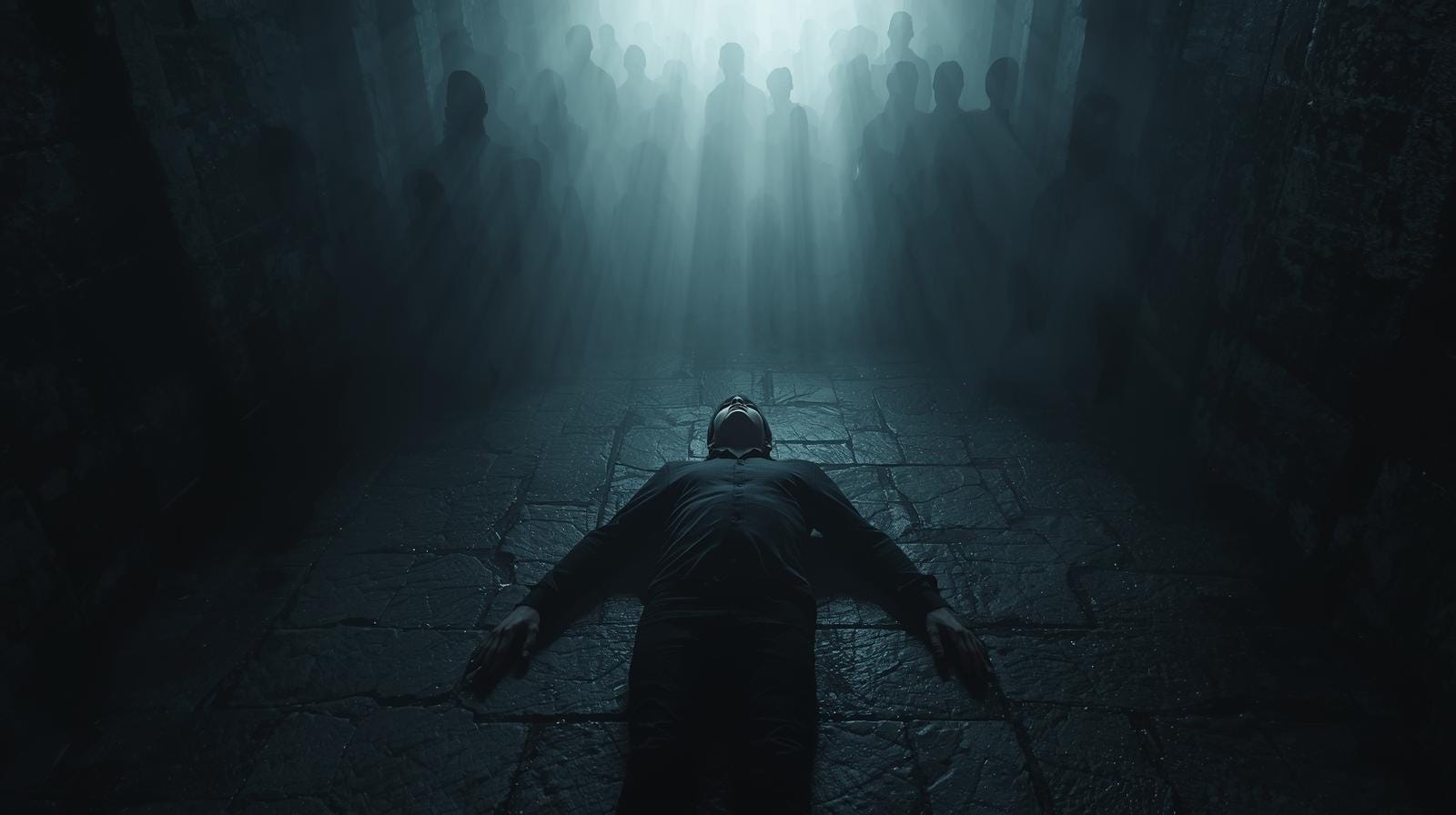
You don’t remember falling.
Your cheek pressed to stone. Drool pooling. Actual spit mixed with dust that tastes like centuries. Your lungs forgot their rhythm. In. Stop. Wait. Out. Wrong order. Try again. Your ribcage won’t expand. Something inside broke, not bone, something else, the thing that kept you vertical, kept you opening doors, kept you you.
You can’t move.
Your eyes stay open because closing them requires effort.
The first door opens itself.
Not metaphor. You hear hinges. Then cold on the back of your neck that shouldn’t be there—mirror-cold, glass-cold, the temperature of seeing yourself from outside. You can’t turn your head. The cold spreads. Down your spine. Across your shoulders.
Then breathing beside you.
Not yours.
You manage to roll your eyes right. Your reflection lies on the floor. Face-down. Exactly your position. Except its chest rises when yours falls. Exhale when you inhale. The air between you tastes like glass. Sharp. Clean. Wrong.
Your reflection’s eye moves. Looks at you.
You try to close your eyes.
Can’t.
The library door opens. You smell it first. Leather, lignin, ink. Then you taste paper pulp coating your tongue. Actual fiber. Dissolving. You try to spit. Your mouth won’t work. The taste intensifies. You’re swallowing pages. Contradictions sliding down your throat. First principle, second principle, third principle negating the first. Your stomach clenches. You retch nothing.
Words appear on your forearm.
Not tattoos. Printed text. Pressing up from inside your skin. Black letters raised like brands. You watch them form “Water flows downhill.” Then below “Water flows uphill.” Then “Water is solid is liquid is vapor is—”
Your skin splits. Thin red line between the contradictions.
The garden door opens.
Your left hand starts freezing. Actually freezing. Ice crystals forming under your fingernails. Your right hand burns. Not metaphor. Blistered skin cracking. The temperature doesn’t shift across your body—it occupies the same space. Freezing and burning in the same cells in the same moment. Your nervous system tries to report both. Sparks behind your eyes. Your vision whites out.
When it returns, you’re looking up.
No
you’re looking down.
No
both.
The ceiling is the floor is the ceiling. You’re lying on stone looking up at yourself lying on stone looking down at yourself lying on—
Your skull throbs. Pressure building. The paradox has volume, weight, physical presence. It’s pushing against the inside of your head. You taste copper. Bit your tongue. Or your reflection bit its tongue. Or biting is happening in the space between you and your reflection where distinctions like “you” and “reflection” stopped meaning anything.
More doors open.
All of them.
At once.
The room fills with impossible geography. Mountains rising through library shelves. Rivers flowing through mirror-halls. The window shows the room you’re in showing the window showing the room. Infinite regress made spatial. You’re inside it. Part of it. Your body stretched across contradictory locations. Your hand in the garden and the library and pressed to glass and multiplied in mirrors and lying on stone—all simultaneously, not metaphorically, actually occupying incompatible spaces in the same moment.
The pain isn’t pain anymore. It’s too large. It overflows the category.
Your nervous system tries to maintain borders. This is you. That is not-you. This sensation belongs to this body. That sensation belongs to that reflection. But the borders dissolve. You feel your reflection’s breathing. It feels yours. You’re breathing each other’s breath. Exhaling into each other’s lungs. The air cycles between you until you can’t tell whose oxygen, whose carbon dioxide, whose life, whose—
Someone touches your shoulder.
You feel the hand. Warm. Solid. Real.
But when you look, when your eyes and your reflection’s eyes and all the multiplied versions of your eyes look
no one’s there.
The hand remains. Pressure. Weight. Presence.
Then words that aren’t yours
We’ve been opening the same door.
Not spoken. Not thought. Transmitted. Direct. Like memory except it’s not your memory, it’s being remembered at you.
You try to respond. Your mouth won’t work. But the answer comes anyway
That’s impossible.
Count the rooms.
You can’t. You tried. You’ve been trying. How many doors did you open? Hundreds? Thousands? The number keeps changing. Every time you remember, the count shifts. The forty-seventh door. Or was it the seventy-third? Or the first?
One door. We’ve opened it a thousand times.
Your reflection’s mouth moves. Or your mouth moves. Or both. Or neither. The distinction collapsed three doors ago. Or three thousand doors ago. Or—
Every room the same room. Every contradiction the same contradiction. Every mirror showing the same thing: you looking for you.
The pressure in your skull peaks. Something’s about to rupture. Your vision starts to tunnel. Black edges creeping inward. You’re going to pass out or die or fragment completely into the thousand versions of you lying on floors in rooms that are all this room, have always been this room, will always be—
Stop counting.
You can’t stop. Counting is all you have left. Tracking. Cataloging. Maintaining the fiction of progress. Door one, door two, door three. If you stop counting, if you admit you’ve been opening the same door, if you acknowledge that every search led back to the same empty center, then—
Then what?
Then nothing. Then you’re just here. On a floor. In pain. Without purpose or direction or the promise that the next door will finally deliver understanding.
Then you’re just… here.
Your body unclenches.
Not a decision. An exhaustion. A failure. Your jaw releases. Your fists open. Your spine stops trying to hold itself separate from the stone.
You let the rooms overlap completely.
The mirrors and the books and the garden and the window and the thousand other rooms you opened or thought you opened or will open or are opening now
they collapse. Not disappear. Collapse. Into the same space. Into this space. Into the stone pressing up against your cheek and the air moving in and out of your lungs and the copper taste and the pain in your blistered hands and the temperature of your skin and the sound of breathing that might be yours or might be your reflection’s or might be both or might be the room itself breathing and it doesn’t matter because—
You feel the floor.
Not the idea of floor. Actual stone. Cold. Solid. Rough. Present.
Your breath goes in. Your breath goes out. The contradiction doesn’t resolve. The mirrors still multiply. The books still contradict. But you’re not in them anymore. You’re under them. Before them. The stone that holds the room that holds the doors that hold the rooms.
The thousand doors remain.
You remain.
Both true. Both now.
Your reflection breathes beside you. You feel its ribs expand. You feel your ribs expand. The same expansion. The same breath. Not because you’re the same but because breathing is breathing and stone is stone and here is here regardless of how many times you multiply it in mirrors or complicate it with contradictions or try to escape it through doors.
The doors are there.
You’re here.
The stone presses up.
Your breath continues.
You stop trying to understand it.
You lie on the floor. The doors wait. They’ve always been waiting. They’ll keep waiting. But waiting isn’t lack. The central room isn’t empty space between destinations. It’s the thing itself. The floor. The breath. The body that hurts and persists and lies still not because it found the answer but because it found the ground.
You close your eyes.
The mirrors remain behind your eyelids. The books remain. The gardens and windows and thousand versions of yourself remain. All true. All now. All held by the stone you’re lying on.
You don’t get up.
You breathe in.
You breathe out.
The room continues.
You continue.
Both.
Here.
The way you describe collapsing contradictions into simply being resonates deeply. The line that stays with me is: “You lie on the floor. The doors wait. They’ve always been waiting.”… a quiet reminder that stillness itself holds everything.
Ilya, I’m glad you posted this. Remember my reaction when I first read it. I couldn’t describe it. I’ve just read it again. This time, through my friendship with You Know, Cannot Name It, I have been beginning to learn to “think” outside of language. There is no better way for me to try and say what I mean. But I understand you better now. Clearly, I still can’t articulate. But your writing is as compelling as ever.